Saturday, 26 February 2022

KNOW WHY BIRDS DON’T GET ELECTRIC SHOCK ON NAKED WIRES !

On a beautiful sunny day, you glance up to find a line of little birds perched on power wires staring down at you. How do they manage to stand on an electric line without getting shocked? It's a valid question because you know that touching that line yourself will very certainly result in a deadly electric shock. 
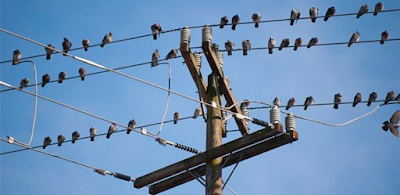
Electrocution is defined as an injury or death caused by an electrical shock. If birds aren't electrocuted while perched on an electric line, they aren't being shocked by electricity. In layman's terms, this means that electricity can travel through the birds without harming them. What are the reasons, however, that birds are not electrocuted? In a nutshell, electricity is generated by electrons moving through conductors. If birds aren't getting shocked as they fly over an electric wire, it suggests the bird isn't a good conductor of electricity. This means that birds do not allow electricity from the cable to go into their bodies.

Birds may sit on power lines because the electrical current ignores the presence of the bird and continues to flow through the wire rather than through the bird's body. The body of a bird is a poor conductor of electricity. Like water, electricity flows with the least amount of resistance possible. Copper wires carry electricity in electrical power cables. Copper is a great electrical conductor, allowing electricity to flow freely over its surface.

On the other hand, a bird is made up of cells and tissues. These cells and tissues do not give a simpler path for the electricity in the wire to travel than the one it is already on. Because a bird's body is not a strong conductor of electricity, the electricity ignores the bird on the wire and proceeds on to its goal along with the copper wiring. 

There’s another reason why birds can sit on a wire without getting shocked. There’s no voltage difference in a single wire. 
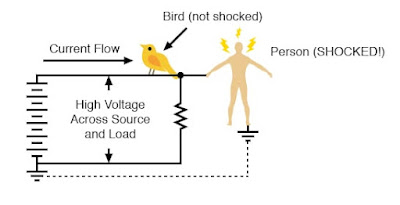

For electrons to move, there must be what scientists call a difference in electrical potential. For example, energy flows from areas of high voltage to areas of low voltage. If it flows through a single power line at 35,000 volts, it will continue along the path of least resistance. That means it’ll bypass birds because there’s no difference in electrical potential. This is not the case with humans as everything circuit is earthed. 
Thank you for taking the time to read this article, hope you found it useful.

Wednesday, 23 February 2022

KNOW WHY THERE IS A ROPE IN POLICE UNIFORM !


Friends, you must have seen that a police officer's costume has a rope in it that goes in his pocket; nevertheless, it is not a regular rope; rather, it is a sort of whistle that is tied to his uniform and hidden in his pocket.


First and foremost, it is not referred to as a rope. It's known as a lanyard, and it's worn by police, military, and paramilitary personnel. The rope on the shoulder of a police officer's uniform is known as a whistle cord or a Lanyard.


A fourragère is a braided string with a sharp spike at one end, often known as a lanyard. The fourragère is a historical military uniform component that originated in French uniforms and was used to bundle food for pack animals or cavalry horses. Lanyards were also employed by artillery troops in the nineteenth century to hold devices that were used to modify the fuses on artillery projectiles. They repositioned the lanyard to be worn over the shoulder for ceremonial uniforms, and it is color-coded to designate a unit or post.
Lanyard is an essential component of army, paramilitary, police, and other security personnel's uniforms. In most police and paramilitary forces, gazetted officers (DSP/ASP and above) wear black lanyards, whereas lower-ranking officers wear khaki ones (depending upon the states in case of the police force). Different lanyards are used by army personnel depending on the regiments in which they are commissioned. Uniform includes lanyards, which frequently have a whistle at the end.


This whistle is used anytime a police officer has to halt a car in an emergency scenario or occasionally has to deliver a message to another police officer who is in difficulties.

However, if a soldier is injured and alone, he can use whistling to alert those around or the rescue squad to his condition. The whistling sound may be heard at a greater distance than one might imagine. Thank you for taking the time to read this article, hope you found it useful.

Tuesday, 22 February 2022

KNOW WHY CRICKETERS USE WHITE POWDER DURING MATCH !

One of the things we've always been curious about is the white cream that cricket players use on their faces. 

Zinc oxide is the white cream that many cricketers use on their faces. Zinc oxide is a physical sunscreen that rests on top of the skin and is known as a reflector. It creates a thick protective coating that helps to deflect the sun's damaging UVA and UVB rays away from the skin. 

Chemical sunscreens, often known as absorbers, are the ones you use every day. These absorb into the skin, allowing UVA and UVB rays to pass through the top layer before being dealt with under the surface. Because cricketers might be exposed to direct sunlight for up to 6 hours during a game, they utilize zinc oxide. Playing five days in a row in the sun is not a simple task during a Test match, and since the players are taking every care to keep healthy, it is critical to pay attention to minor details.


This much sun exposure may be dangerous, therefore protecting your skin with a reflecting physical sunscreen like Zinc oxide on vulnerable regions is the safest method to avoid skin damage. Zinc creams, even colored ones, are effective because a thick coating of the cream filters all UVA and UVB rays, ensuring that ears, noses, and cheeks are protected.   

Compared to traditional chemical sunscreens, zinc oxide has a number of advantages:

Zinc oxide gets to work right away. The majority of chemical sunscreens advocate waiting 20 minutes after application before going outside in the sun. When it comes to zinc oxide lotion, you're good to go as soon as you apply it. It's gentle enough for even the most delicate skin. Chemical sunscreens, on the other hand, might irritate the skin. Zinc oxide can aid in skin healing and irritation reduction. Thank you for taking the time to read this article, hope you found it useful.