Saturday, 7 April 2018

MODES OF HEAT TRANSFER : CONDUCTION,CONVECTION AND RADIATION EXPLAINED !!

Heat, energy that is transferred from one body to another as the result of a difference in temperature.Heat will always be transferred from higher temperature to lower temperature independent of the mode. The energy transferred is measured in Joules (kcal or Btu). The rate of energy transfer, more commonly called heat transfer, is measured in Joules/second  (kcal/hr or Btu/hr). 

Heat is transferred by three primary modes:


  • Conduction (Energy transfer in a solid)
  • Convection (Energy transfer in a fluid)
  • Radiation (Does not need a material to travel through)

CONDUCTION :

Conduction is the transfer of heat between substances that are in direct contact with each other. The better the conductor, the more rapidly heat will be transferred.If one body is at a higher temperature than the other, the motion of the molecules in the hotter body will vibrate the molecules at the point of contact in the cooler body and consequently result in increase in temperature.   The amount of heat transferred by conduction depends upon the temperature difference, the properties of the material involved, the thickness of the material, the surface contact area, and the duration of the transfer. 

Metals are good conductors of heat, while gaseous substance, having low densities or widely spaced molecules, are poor conductors of heat. Poor conductors of heat are usually called insulators. The measure of the ability of a substance to insulate is its thermal resistance. This is commonly referred to as the R-value (RSI in metric).  The R-value is generally the inverse of the thermal conductivity, the ability to conduct heat.

Typical units of measure for conductive heat transfer are:

Per unit area (for a given thickness)
Metric (SI) :  Watt per square meter (W/m)
Overall 
Metric (SI) :  Watt (W)  or kilowatts (kW)

CONVECTION :


When a fluid, such as air or a liquid, is heated and then travels away from the source, it carries the thermal energy along. This type of heat transfer is called convection. The fluid above a hot surface expands, becomes less dense, and rises.There are two types of convection: natural and forced. In case of natural convection, the fluid in contact with or adjacent to a high temperature body is heated by conduction. As it is heated, it expands, becomes less dense and consequently rises. This begins a fluid motion process in which a circulating current of fluid moves past the heated body, continuously transferring heat away from it. In the case of forced convection, the movement of the fluid is forced by a fan, pump or other external means.  A centralized hot air heating system is a good example of forced convection.  

Units of measure for rate of convective heat transfer are:
Metric (SI) : Watt (W) or kilowatts (kW)

RADIATION:


Radiation is a method of heat transfer that does not rely upon any contact between the heat source and the heated object as is the case with conduction and convection. Heat can be transmitted through empty space by thermal radiation often called infrared radiation. This is a type electromagnetic radiation . No mass is exchanged and no medium is required in the process of radiation. Examples of radiation is the heat from the sun, or heat released from the filament of a light bulb.

Typical units of measure for rate of radiant heat transfer
Metric (SI) ——Watt per square meter 

If you find this article helpful kindly share it with your friends and if you want to add something to it feel free to write in comment box.

Thank You !

ENGINE CONTROL UNIT-SIMPLE AND PRECISE INFORMATION !!

ECU-Engine control unit, is a control unit that controls your engine. It determines the amount of fuel, ignition timing and other parameters whether a bike or a car needs to keep running smoothly.

Your bike or car equipped with it has got many sensors that continuously monitors the engine. The ECU reads the input values and decides what is the correct value required at the given condition. The input values can be collected from various sensors like crankshaft position sensor, air temperature sensor, oxygen sensor, Throttle position sensor and gives the data values to the ECU.

So a bike equipped with an ECU don't have a carburetor instead it uses a fuel injector to deliver the fuel. Suddenly if you raise the throttle, the ECU can sense it and can deliver the optimum amount of air/fuel required. 

Suppose If you ride your machine in a hilly terrain on higher altitudes more than 4000 metres, the oxygen level will be marginally less when compared to the sea level. The bike which uses an ECU will be more efficient when compared to a carburetted one, since it optimizes the right amount of fuel to be delivered for the changing conditions in environment. Optimum performance and efficiency - both can be obtained by using an ECU.

DIFFERENCE BETWEEN CRANKSHAFT AND CAMSHAFT EXPLAINED !!

Crankshafts:

The crankshaft is an engine component that converts the linear (reciprocating) motion of the piston into rotary motion. The crankshaft is the main rotating component of an engine and is commonly made of ductile iron.
All major components of the engine like piston,connecting rod etc. are supported by this shaft.

Construction Of Crankshaft:

A crankshaft is simply the same as an eccentric, except the eccentric is a much smaller diameter than the shaft itself Crankshaft length mainly depends on number of cylinders are present in engine .Firing order also considered while designing the Crankshaft .

Location :  Crankshaft is located in crank case . On Crankshaft, Connecting rods and pistons are mounted. The crankshaft rides on bearings which can wear down over time. The bearings support the crankshaft and also the rods which connect the pistons to the crankshaft.

Applications :It actually part of an engine where the power is available , and this power is transferred in the form of torque to clutch and thereby  gearbox and wheels.The main function is to convert liner motion of the piston to useful rotary motion.


Camshafts:

Camshaft is a part of engine which is responsible for opening and closing of exhaust and inlet valves.As the engines work they need to breathe out exhaust gases and take in fresh air ( charge) for the next cycle to take place . All these processes need to take place at a designated time with respect to each other. These processes are timed through opening and closing of valves and actuation of fuel pumps through a actuating mechanism which is triggered by movement of the crankshaft. The camshaft comes into picture here. The Crankshaft drives through a belt or chain drive the camshaft on which the inlet,exhaust, fuel pump cams are fitted for each unit when the crankshaft rotates it in turn rotates the camshaft which precisely actuate the valve and fuel pumps.

Construction Of Camshafts:
 A camshaft is a long bar with egg-shaped eccentric lobes, one lobe for each valve and fuel injector.
The relationship between the rotation of the camshaft and the rotation of the crankshaft is of critical importance. Since the valves control the flow of the air/fuel mixture intake and exhaust gases, they must be opened and closed at the appropriate time during the stroke of the piston. For this reason, the camshaft is connected to the crankshaft either directly, via a gear mechanism, or indirectly via a belt or chain called a timing belt or timing chain.

Location : Depending on the location of the camshaft, the cam operates the valves either directly or through a linkage of pushrods and rockers. Direct operation involves a simpler mechanism and leads to fewer failures, but requires the camshaft to be positioned at the top of the cylinders.
Applications :This shaft receives the power from crankshaft  (1:2) and operates the engine valves through cam and follower mechanism(generally mushroom headed follower is used to reduce friction b/w cam and follower).

WHY REAR WHEELS IN AUTO-RICKSHAW ARE TILTED OUTWARDS ??

You might have seen that rear wheels of auto rickshaw are tilted outside.What is the purpose of this?Does it not lead to tyre wear?We will all discuss about this here.
First of all we should learn about an amazing concept which is known as "Camber angle." 

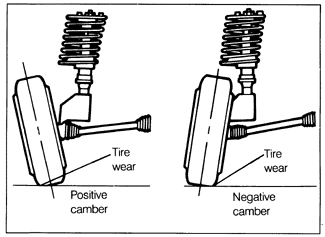
Camber angle is the angle made by the wheels of a vehicle; specifically, it is the angle between the vertical axis of the wheels used for steering and the vertical axis of the vehicle when viewed from the front or rear.If the top of the wheel is farther out than the bottom (that is, away from the axle), it is called positive camber; if the bottom of the wheel is farther out than the top, it is called negative camber.So,in case of three wheeler we have positive camber.
Now let us understand why this positive camber is provided in auto rickshaws.
A three wheeler or what we call as auto rickshaw  generally transports a whole lot of passengers.(at least 6 passengers in the passenger bay) in a single trip. That is approximately 360 kg(considering each passenger's mass to be 60 kg). In figure above if you see the image depicting positive camber,you will notice that the tire contact patch is more towards the region near the outside tire wall. This is the scenario when the rickshaw is in unloaded condition. 


Now when the rickshaw gets loaded , the normal force due to the weight of the passengers causes an anticlockwise moment on the axle supporting the wheels, making the wheels to attain neutral or no camber condition. Thus when the vehicle is loaded there is greater contact patch thus better traction.

If the wheels had the neutral camber in the static unloaded condition, during the loaded scenario the wheels will reach the negative camber alignment resulting in reduced contact patch and uneven tire wear(near the inside tire wall).


Friday, 6 April 2018

KNOW WHY 2 STROKE ENGINES ARE USED IN SHIPS !!

Although 2 Stroke Engines create a lot of noise and pollution but still ship engine uses 2 stroke engine for their propulsion.Let us know the reason behind this:

1.)Fuel Selection: 

High grade fuel are more costly as compared to low grade fuel.A two stroke engine can burn low grade fuel oil and hence reduce running cost of the ship.

2.)High Torque:

 2 stroke engine has more torque at low rpm than the 4 stroke. The ship needs the higher torque to keep a constant speed at the lower engine speed. So the ship can cruise at a constant speed without having to constantly adjust the engine speed.

3.)Power:

Most of the 2 stroke engines are now large stroke engines that produce more power. Hence they have high power to weight ration as compare to 4 stroke engine.

4.)Reliability:

Two stroke engines are more reliable in operation as compare to 4 stroke engine.


5.)Less Maintenance:

Due to absence of valve mechanism,the maintenance requirement of two stroke engine is much lesser than 4 stroke engine.

6.)No reduction attachments

As two stroke engines are low speed engine, there are no requirement of reduction gear or speed reduction arrangement as required for high speed four stroke engine.

MECHANICAL PROPERTIES OF MATERIAL,EVERY MECHANICAL ENGINEER MUST KNOW !!!

The mechanical properties of a material are those which effect the mechanical strength and ability of material to be molded in suitable shape. 

Some of the typical mechanical properties of a material are listed below-

#1. Strength:

The ability of material to withstand load without failure is known as strength. If a material can bear more load, it means it has more strength. Strength of any material mainly depends on type of loading and deformation before fracture. According to loading types, strength can be classified into three types.

a. Tensile strength:
b. Compressive strength:
3. Shear strength:

According to the deformation before fracture, strength can be classified into three types.

a. Elastic strength:
b. Yield strength:
c. Ultimate strength:

#2. Homogeneity:

If a material has same properties throughout its geometry, known as homogeneous material and the property is known as homogeneity. It is an ideal situation but practically no material is homogeneous.

#3. Isotropy:

A material which has same elastic properties along its all loading direction known as isotropic material.

#4. Anisotropy:

A material which exhibits different elastic properties in different loading direction known as an-isotropic material.

#5. Elasticity:

If a material regain its original dimension after removal of load, it is known as elastic material and the property by virtue of which it regains its original shape is known as elasticity.

Every material possess some elasticity. It is measure as the ratio of stress to strain under elastic limit.

#6. Plasticity:

The ability of material to undergo some degree of permanent deformation without failure after removal of load is known as plasticity. This property is used for shaping material by metal working. It is mainly depends on temperature and elastic strength of material.

#7. Ductility:

Ductility is a property by virtue of which metal can be drawn into wires. It can also define as a property which permits permanent deformation before fracture under tensile loading. The amount of permanent deformation (measure in percentage elongation) decides either the material is ductile or not.

Percentage elongation = (Final Gauge Length – Original Gauge Length )*100/ Original Gauge Length

If the percentage elongation is greater than 5% in a gauge length 50 mm, the material is ductile and if it less than 5% it is not.

#8. Brittleness:

Brittleness is a property by virtue of which, a material will fail under loading without significant change in dimension. Glass and cast iron are well known brittle materials.

#9. Stiffness:

The ability of material to resist elastic deformation or deflection during loading, known as stiffness.  A material which offers small change in dimension during loading is more stiffer. For example steel is stiffer than aluminum.

#10. Hardness:

The property of a material to resist penetration is known as hardness. It is an ability to resist scratching, abrasion or cutting. 

It is also define as an ability to resist fracture under point loading.

#11. Toughness:

Toughness is defined as an ability to withstand with plastic or elastic deformation without failure. It is defined as the amount of energy absorbed before actual fracture.

#12. Malleability:

A property by virtue of which a metal can flatten into thin sheets, known  as malleability. It is also define as a property which permits plastic deformation under compression loading.

#13. Machinability:

A property by virtue of which a material can be cut easily.

#14. Damping:

The ability of metal to dissipate the energy of vibration or cyclic stress is called damping. Cast iron has good damping property, that’s why most of machines body made by cast iron.

#15. Creep:

The slow and progressive change in dimension of a material under influence of its safe working stress for long time is known as creep. Creep is mainly depend on time and temperature. The maximum amount of stress under which a material withstand during infinite time is known as creep strength.

#16. Resilience:

The amount of energy absorb under elastic limit during loading is called resilience. The maximum amount of the energy absorb under elastic limit is called proof resilience.  

#17. Fatigue Strength:

The failure of a work piece under cyclic load or repeated load below its ultimate limit is known as fatigue. The maximum amount of cyclic load which a work piece can bear for infinite number of cycle is called fatigue strength. Fatigue strength is also depend on work piece shape, geometry, surface finish etc.

#18. Embrittlement:

The loss of ductility of a metal caused by physical or chemical changes, which make it brittle, is called embrittlement.

Thursday, 5 April 2018

MACHINABILITY & MACHINABILITY INDEX EXPLAINED !!!


MACHINABILITY

Machinability is a term indicating how the work material responds to the cutting process. In the most general case good machinability means that material is cut with good surface finish, long tool life, low force and power requirements, and low cost.

MACHINABILITY INDEX

It is a numerical value that designates the degree of difficulty or ease with which a particular material can be machined.

The machinability index KM is defined by

KM = V60/V60R
where ,
  • V60 is the cutting speed for the target material that ensures tool life of 60 min,
  • V60R is the same for the reference material. Reference materials are selected for each group of work materials (ferrous and non-ferrous) among the most popular and widely used brands.
If KM Greater than 1, the machinability of the target material is better that this of the reference material, and vice versa. Note that this system can be misleading because the index is different for different machining processes.
Example: Machinability rating
The reference material for steels, AISI 1112 steel has an index of 1.
For a tool life of 60 min, the AISI 1045 steel should be machined at 0.36 m/s.
Hence, the machinability index for this steel is,
KM = 0.36/0.5 = 0.72.
This index is smaller than 1, therefore, AISI 1045 steel has a worse workability than AISI 1112.

WAYS OF IMPROVING MACHINABILITY INDEX:

The machinability of the work materials can be more or less improved, without sacrificing productivity, by the following ways :
• Favourable change in composition, microstructure and mechanical properties by mixing suitable type and amount of additive(s) in the work material and appropriate heat treatment.

• Proper selection and use of cutting tool material and geometry depending upon the work material and the significant machinability criteria under consideration.

• Proper selection and appropriate method of application of cutting fluid depending upon the tool – work materials, desired levels of productivity i.e., VC and so and also on the primary objectives of the machining work undertaken.

• Proper selection and application of special techniques like dynamic machining, hot machining, cryogenic machining etc, if feasible, economically viable and eco-friendly.